Cut finance bosses’ bonuses when talent is held back, report urges


Financial services bosses should face financial consequences when their firms fail to develop and retain underrepresented talent, according to a report warning that AI could automate and accelerate the industry’s existing blind spots.
The proposal is among the recommendations in Think Again: Why UK Financial Services Must Act Now on AI-Era Resilience, by Samantha Emery, Nadia Edwards-Dashti and Bill Oates.
The paper connects decisions about who gets hired, promoted or pushed out with a bigger question: whether financial services is equipped to challenge its own assumptions as AI spreads. Its analysis combines published research with evidence from more than 650 recorded executive conversations over five years.
The report also carries a foreword endorsement from Sir Ron Kalifa, former non-executive director and senior independent director of the Bank of England. He describes it as an “important contribution” to the debate, welcoming its focus on the people, ideas and perspectives that make financial services more resilient.
The bonus proposal is one part of a bigger argument: how firms treat their people affects their ability to spot risk. As AI spreads across financial services, the authors warn that excluding different perspectives could leave more institutions making the same mistakes, faster.
____________________________________________________________________________
When progress affects pay
There is already a framework for connecting the two. The Women in Finance Charter asks signatories to commit to linking senior executive pay to internal gender diversity targets.
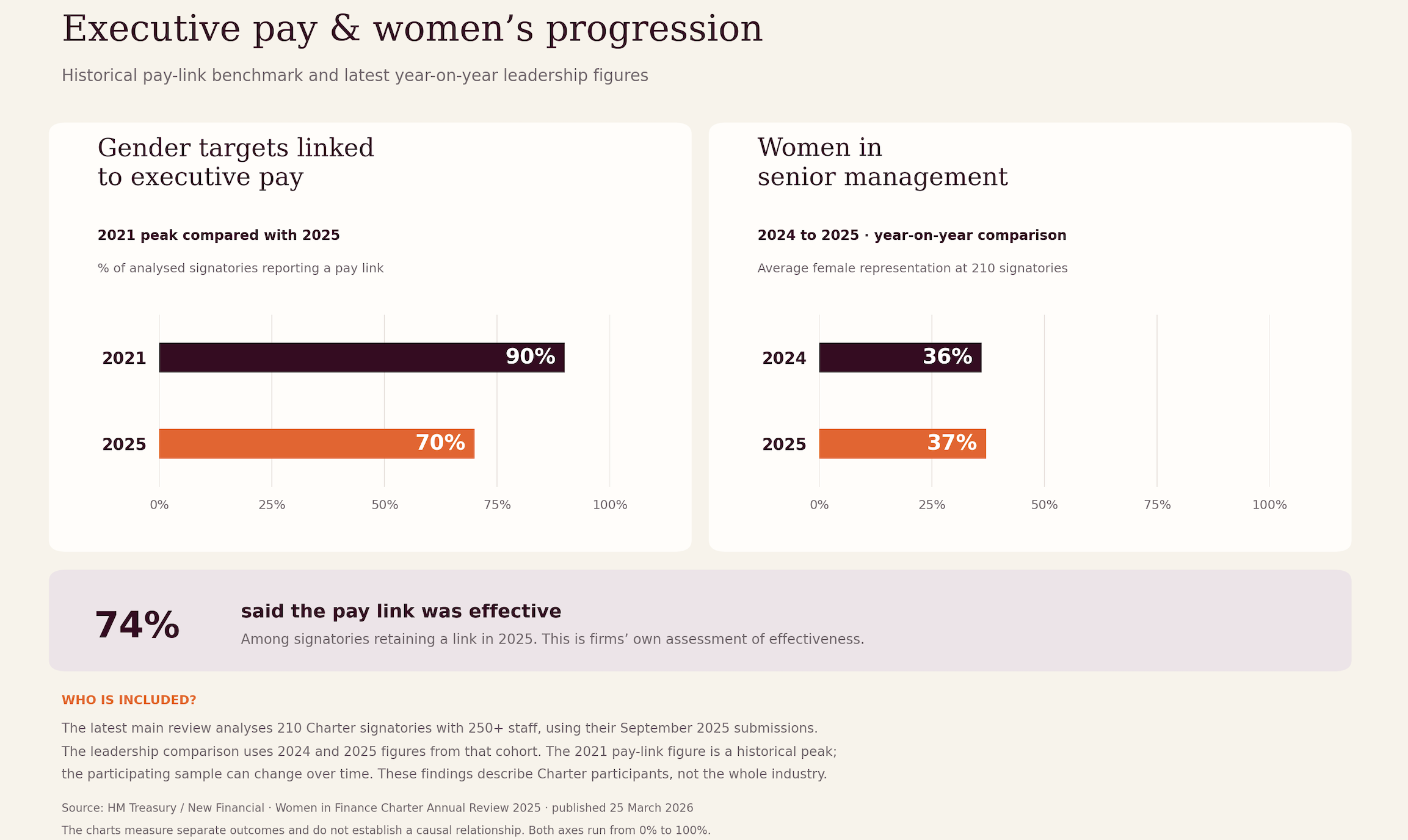
Yet the proportion reporting such a link has fallen from a peak of 90% in 2021 to 70%, according to the latest annual review. Among firms retaining the link, 74% said it was effective, although that assessment came from the employers themselves. The Charter focuses on gender.
Older workers, disabled employees and people from different ethnic backgrounds aren’t covered by equivalent targets within it. The report would widen that accountability.
Even on gender, progress is slow. Across the 210 signatories analysed, women’s average representation in senior management crept from 36% to 37% in 2025.
But what counts as getting ahead? A better title doesn’t always bring more influence, and staying in a job doesn’t mean your career is going anywhere.
As firms reorganise around AI, who gets retrained and who gets made redundant matters too. Better numbers in the boardroom could hide a very different story elsewhere in the business.
____________________________________________________________________________
Who gets to challenge the machine?
The authors draw parallels with the groupthink associated with the financial crisis. As firms rely on similar AI systems, shared assumptions and blind spots - this groupthink could spread faster and across more institutions.
Keeping a human involved may appear to provide oversight. In practice, much depends on whether they understand an automated recommendation, can investigate its basis and have permission to disagree.
A junior colleague may spot a problem that a senior committee misses. Whether that changes anything depends on how seriously they’re taken, particularly when raising it would delay a project or challenge someone influential.
Training people to recognise a problem is only part of the job. They also need to know what they can do about it, who will listen and whether speaking up will come back to haunt them. A seat in the meeting means considerably less if the decision has effectively been made before they arrive.
____________________________________________________________________________
Making the invisible work count
The authors also propose paying employee network leaders for their contribution and expanding regulatory scrutiny of AI into employment decisions. Their recommendations bring attention to work that can remain largely invisible in conventional measures of performance.
Mentoring colleagues, organising networks and supporting people through difficult moments all take time. A business may encourage these activities while continuing to reward the people whose contribution is easier to count.
There is an obvious tension when someone is praised for helping colleagues succeed, then finds that the time spent doing so has weakened their own case for promotion. Recognising that contribution would require employers to make choices about workload, pay and progression.
Otherwise, the same dependable people can keep picking up work that everyone appreciates but nobody quite treats as part of the job.
____________________________________________________________________________
From the report to the boardroom
The report calls for policymakers to coordinate the sector’s transition into AI, with boards and regulators examining the structures that shape opportunity and decision-making.
For those reading, a useful starting point would be to put it in front of the people responsible for pay, promotion, restructuring and AI adoption. Ask them how the business would measure up.
Who is progressing? Whose expertise changes a decision? What happens when someone challenges an automated recommendation, or a senior colleague?
The answers should tell a board something about the organisation it is running. The test comes when they change what it does: who gets promoted, whose challenge is heard, or what a leader gets paid.
With leadership crises and technology outages making headlines, the report’s questions feel far from theoretical. Who gets challenged, which assumptions go unchecked and how much trust rests with a handful of people or systems are questions businesses can’t afford to leave until something goes wrong.
Read Think Again: Why UK Financial Services Must Act Now on AI-Era Resilience.